
Your funnel isn't broken, your design is
Is your organization struggling with the hiring process? Is your applicant screening driving hiring success, or just processing volume? If you’re not seeing the results you need, the problem probably sits at the top of your funnel, where hiring outcomes are often decided. Despite this, it is the workflow stage that usually gets the least design attention. Organizations will deploy basic, out-of-the-box screening tools, set up some quick filters, deploy often-untested agents, and then walk away… And then six months later they come to us for help. In today’s article, we’re going to look at what top of the funnel represents and why it’s important, discuss four common design oversights, and how to design it for success.
Table of Contents
What is the hiring funnel?
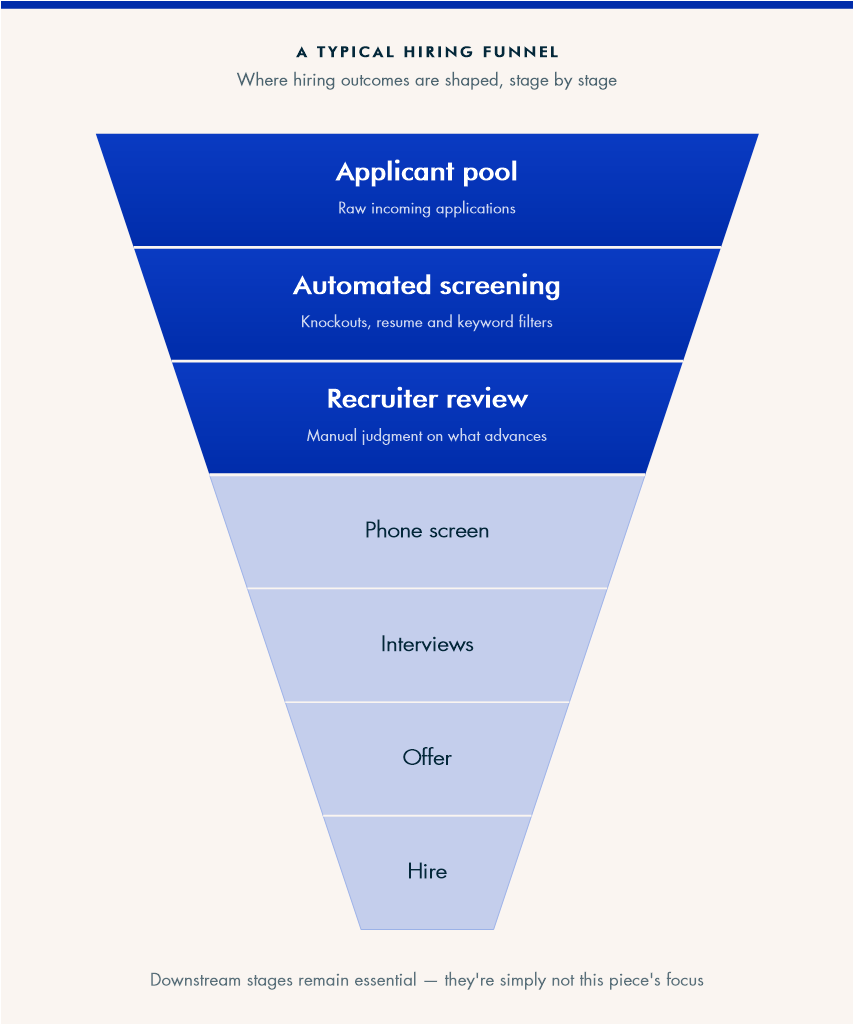
The Hiring Funnel represents the stages of your hiring workflow and is structured like a funnel to visualize the narrowing volume of candidates (or narrowing gap of eligibility) as the hiring process moves forward. As a rule, for each hire, you should always have more candidates at the start of the process than the end. In parallel, the level of scrutiny should always escalate; the applicant pool should only be scrutinized for basic eligibility, whereas interviews explore specific skills, and by the time a candidate has reached the offer stage, a thorough background check has often been performed.
This basic model should be familiar to you, but we’re sharing it to illustrate how important the top of the funnel is: not only is it the entry point for every candidate you will process, but it’s also the stage that the highest number of candidates will pass through. A well-designed top-of-funnel is essential for an effective hiring strategy. It doesn’t guarantee a successful hire but will drive more efficient hiring across the organization. Despite that importance, it is often overlooked in favor of areas that are more “strategic”.
Common design failures
Whether deliberately designed or not, every organization has a hiring funnel. When helping organizations assess their hiring process effectiveness, we generally see four common choices that are indicative of an under-designed funnel:
Overreliance on automated screening tools
Many organizations opt to deploy automated screening tools as a singular way to limit the applicant pool. While automated screening tools like AI agents, semantic keyword filters, and screening questions can all be an effective part of candidate screening, none of them are a complete solution on its own. Tools that are built once and then operate silently are vulnerable to missing context, changing priorities, and bias. The aggressive way these tools are marketed, the ease with which they’re deployed, and their low up-front costs can result in them supplanting a complete design.
Poor UI consideration
No matter how well optimized your system is, you will always get more applicants than you can hire, and it will fall on someone to recruit the best candidates in the pool. What many organizations fail to consider is how to design (and maintain) their system’s UI to facilitate this process. When the system is not efficient at surfacing key information and facilitating navigation, users frequently resort to habitual pattern-matching, skipping steps, and generally following the path of least resistance.
Overlooking the human side of the equation
Beyond the UI and filtering tools in your recruitment tech stack, it is important that an organization’s people are given deliberate thought. Are recruiters trained on how to use the system? Are company hiring goals and policies and practices well articulated and delivered in an impactful way? When users are poorly trained, they tend to rely on learned behaviour that might not suit the company context or rely overly on the system’s outputs without giving it necessary critical consideration.
Not deploying automation where it can be most impactful
We called out an over-reliance on automation above; this doesn’t suggest that automation is bad, just that it is often misapplied. Not having enough automation can result in an inverse failure: obvious disqualifiers (licensing, location, work eligibility) are not screened for, resulting in a polluted candidate pool and wasted recruiter effort. These areas are often overlooked in lieu of flashier AI/automation tools that are marketed as being capable of replacing real human judgement and effort. Automation is most effective when it absorbs low-judgment tasks. Basic eligibility screening often falls into that gap: overlooked by vendors selling more sophisticated tools and by teams designing the process, because neither sees it as impactful.
Deliberate top-of-funnel design
So what does a well-designed top of the funnel actually look like? Each of the four oversights above has a direct fix, and none of them require new technology so much as intentional choices about the technology you already have.
- Configure your tools around your criteria, not the other way around. Automated screening should execute a filter logic your team has explicitly defined, not the default settings a vendor shipped. Configuration should trace back to your actual hiring criteria, and someone should own revisiting it as those criteria change. A filter built once and left untouched is exactly the failure we described above.
- Design for review, not just volume. When evaluating or configuring screening tools, prioritize how easily a recruiter can actually look at a candidate over how much volume the tool can process. If the path of least resistance is skimming or skipping steps, that is a design failure, not a user failure.
- Invest in the human side of the filter. Pair every tooling decision with deliberate training on why the filter works the way it does, not just how to operate it, and make sure hiring goals and criteria are clearly articulated to the people applying judgment. Judgment that is not grounded in explicit criteria becomes inconsistent and difficult to repeat.
- Automate the obvious disqualifiers. Licensing, location, and work eligibility are rarely a matter of judgment, and automating them frees recruiter attention for candidates who were actually viable in the first place.
None of this guarantees a good hire. A well-designed top of the funnel is foundational, but the stages that follow, interviews, hiring manager alignment, and disciplined decision-making, carry more of the weight in producing a good outcome. Get the top of the funnel wrong, and every stage after it inherits the damage. Get it right, and you have earned a fair shot, not a guaranteed one.
Conclusion
Every organization has a hiring funnel, whether or not it was designed on purpose. The organizations getting the best outcomes are not necessarily using better tools; they are the ones who have made deliberate choices about how candidates move through the top of that funnel, and why. Getting the top of the funnel right will not guarantee a great hire, but getting it wrong will make every later stage work harder than it needs to.
If you are not sure whether your funnel reflects a deliberate design or an accumulation of defaults, we would be glad to talk through it with you.